If you work in medical billing, chances are you’ve come across the term “entity code” while reviewing EDI claims, payer rejections, or clearinghouse edits. The problem is that the term often sounds more complicated than it actually is.
Many billing professionals confuse entity codes with identifiers like NPIs, tax IDs, or payer IDs. In reality, entity codes serve a completely different purpose: they tell the system who a specific piece of information belongs to within a claim transaction.
Understanding entity codes is essential because even a small mistake can lead to claim rejections, delayed payments, or failed adjudication.
What Is an Entity Code?
An entity code identifies the role of a party inside an EDI healthcare transaction.
Think of a medical claim as a digital form with multiple participants:
- Billing provider
- Rendering provider
- Payer
- Patient
- Subscriber
- Service facility
- Referring provider
The system needs a standardized way to identify who each participant is. That’s where entity codes come in.
In simple terms, an entity code identifies the role someone plays in a claim.
Not their actual ID number.
Not their NPI.
Not their tax ID.
Their role.
Like:
- Who’s billing for the service?
- Who actually performed it?
- Who’s the payer?
- Who’s the patient?
- Who referred the patient?
The entity code answers those questions.
Example of an Entity Code in an 837 Claim
Here’s a simple example from an 837P EDI file:
| NM1*85*2*SUNRISE CLINIC*****XX*1234567893~ |
That looks messy at first, but it’s actually structured pretty logically.
Here:
- 85 tells the system this is the billing provider
- 2 says the entity is an organization
- XX means the identifier is an NPI
- 1234567893 is the actual NPI number
This is where billing teams get confused.
The entity code is not the NPI. The entity code only defines the role attached to that NPI.
That distinction is important.
Why Entity Codes Matter in Medical Billing
This is the part many new billers underestimate. Claims can reject even when the NPI itself is valid.
Why?
Because EDI systems validate:
- the role
- the loop placement
- the entity type
- the identifier qualifier
- and the identifier itself
So if the provider is placed in the wrong loop, the payer may reject the claim immediately.
That can lead to:
- clearinghouse edits
- 277CA rejections
- payer validation errors
- front-end claim failures
And often, the problem is something tiny.
For example:
- rendering provider submitted as billing provider
- organization marked as individual
- payer ID entered incorrectly
- missing entity qualifier
Small structural issues can stop a claim before adjudication ever starts.
Common Entity Codes Used in Medical Billing
These are some of the most common entity codes billers see in HIPAA EDI transactions.
| Entity Code | Meaning |
| 85 | Billing Provider |
| 82 | Rendering Provider |
| PR | Payer |
| IL | Subscriber |
| QC | Patient |
| 77 | Service Facility |
| 71 | Attending Provider |
| 41 | Submitter |
| 40 | Receiver |
Once you start reviewing EDI claims regularly, these codes become very familiar.
What’s the Difference Between an Entity Code and an NPI?
This is probably the biggest misunderstanding in medical billing.
Here’s the easiest way to think about it:
| Item | Purpose |
| Entity Code | Defines the role |
| NPI | Identifies the provider |
Example:
| NM1*85*2*…*XX*1234567893~ |
- 85 = billing provider role
- XX = identifier type (NPI)
- 1234567893 = actual provider identifier
So the entity code explains who the entity is in the claim.
The NPI identifies the actual provider.
Understanding Entity Type Qualifiers
When insurance companies process an electronic claim, they also need to know whether the entity is:
- an individual person
- or an organization
That’s where entity type qualifiers become important.
These qualifiers help the payer’s system correctly interpret provider names, enrollment records, and identifiers.
| Value | Meaning |
| 1 | Individual Person |
| 2 | Organization |
For example:
NM1*82*1*JONES*AMY
In this example:
- 82 identifies the rendering provider
- 1 tells the payer the rendering provider is an individual person
Since Amy Jones is an individual healthcare provider, the claim correctly uses the person qualifier.
Now compare that to this:
NM1*85*2*SUNRISE CLINIC
Here:
- 85 identifies the billing provider
- 2 tells the payer the billing provider is an organization
Because Sunrise Clinic is a healthcare facility or business entity, it uses the organization qualifier.
This may seem like a very small detail, but it’s actually a common cause of claim rejections.
For example:
- a group practice submitted as an individual
- a physician submitted as an organization
- enrollment records not matching claim structure
- group NPI and individual NPI confusion
EDI systems validate this information very strictly, which is why entity type qualifiers matter so much in clean claim submission.
Where Entity Codes Appear on Claims
One thing that confuses many newer billers is that entity codes are much more visible in EDI claims than on paper claims.
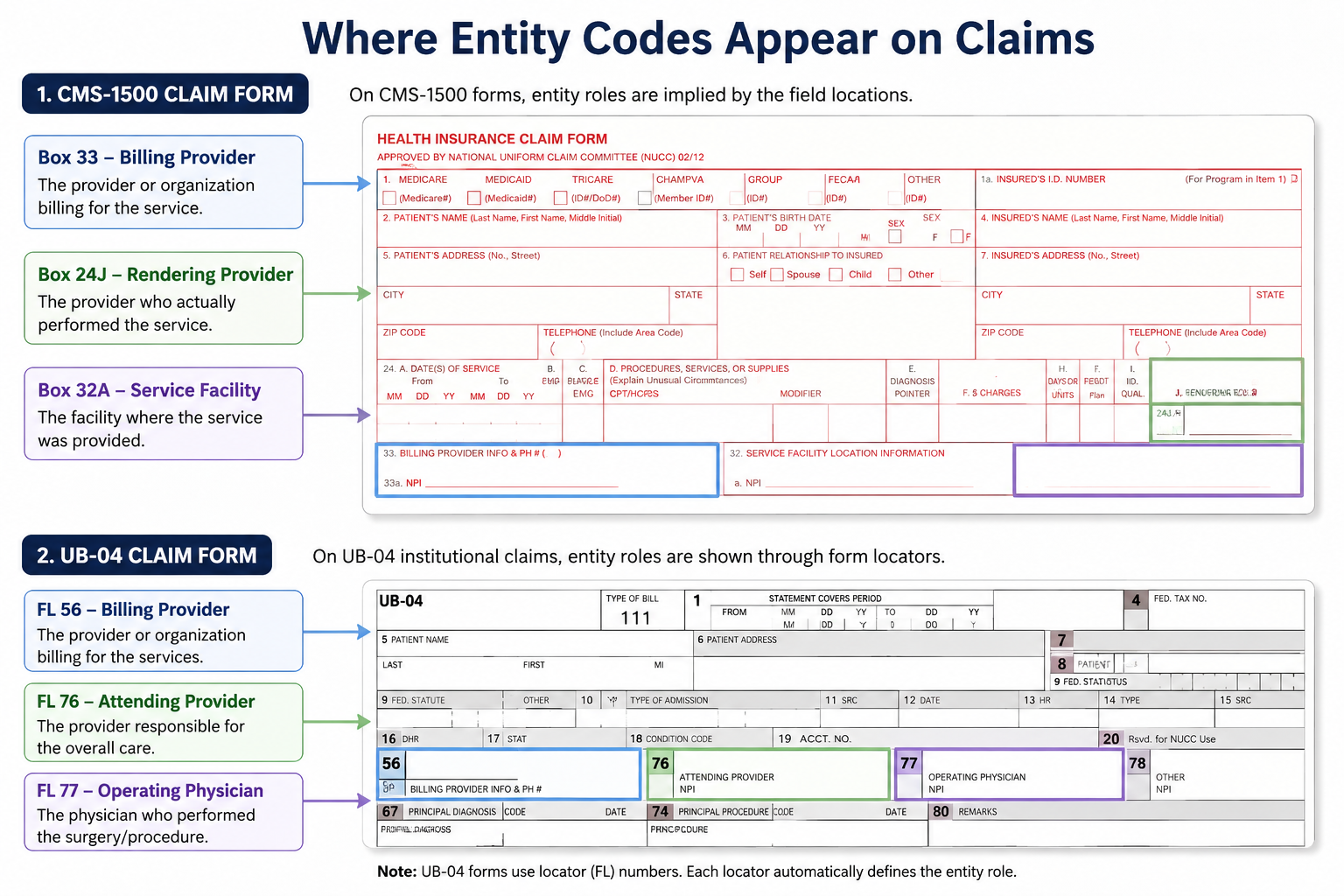
On paper claims, the form layout itself usually defines the provider role automatically.
Electronic claims require those roles to be explicitly coded using loops and segments.
CMS-1500 Claims
On CMS-1500 professional claims, different boxes already represent specific provider roles.
For example:
| Field | Purpose |
| Box 33 | Billing Provider |
| Box 24J | Rendering Provider |
| Box 32A | Service Facility |
This means the payer already understands the entity role based on where the information appears on the form.
For example:
- Box 33 always contains billing provider information
- Box 24J contains rendering provider details
- Box 32A identifies the service facility location
That’s why you don’t actually see entity codes like “85” printed anywhere on a paper CMS-1500 form.
In EDI claims, those same provider roles are represented through:
- NM1 segments
- provider loops
- entity codes
- qualifiers
instead of physical boxes on a form.
UB-04 Institutional Claims
UB-04 claims work similarly, but instead of boxes, they use Form Locators (FLs).
Examples include:
| Form Locator | Purpose |
| FL 56 | Billing Provider |
| FL 76 | Attending Provider |
| FL 77 | Operating Physician |
Again, the location of the information automatically defines the provider role.
For example:
- FL 56 identifies the billing provider
- FL 76 identifies the attending physician
- FL 77 identifies the operating physician
In electronic institutional claims (837I), those same provider roles are represented through EDI loops and entity codes instead of form locators.
This is one reason billers transitioning from paper claims to EDI often feel overwhelmed at first.
Paper claims visually organize provider roles for you.
EDI claims require every role, identifier, and qualifier to be structured correctly within the transaction itself.
Common Entity Related Errors in Medical Billing
This is usually where most billers first encounter entity codes. When claims reject, the payer explanation often identifies the issue by referencing an entity.
1- Invalid HICN or Claim Number
Payers reject corrected claims when billers leave out the original claim number or enter the wrong one.
The payer uses that number to locate the original claim in its system. Without it, the payer cannot connect the corrected claim to the earlier submission.
Billers usually see this error on:
- corrected claims
- replacement claims
- voided claims
To fix the issue:
- review the original claim
- copy the exact payer-assigned claim number
- confirm the correct resubmission type before sending the claim again
2- Invalid Member or Subscriber Number
This error points to a problem with the patient’s insurance information.
Billers usually trigger this error when they:
- enter the wrong member ID
- choose the wrong payer
- submit outdated insurance information
- use inactive coverage
Newborn claims also trigger this error frequently because parents often submit claims before the insurance company adds the baby to the policy.
To resolve the issue:
- verify eligibility
- confirm the payer ID
- review subscriber information carefully
- contact the payer if the member ID does not validate
3- Missing Entity Code
Payers trigger this error when the claim does not clearly identify a provider, patient, facility, or other entity.
In most cases, the biller:
- leaves out an NM1 segment
- places the provider in the wrong loop
- enters incomplete provider information
- uses the wrong qualifier
Billers should review:
- billing provider information
- rendering provider details
- referring provider information
- patient and subscriber data
EDI claims require every entity to appear in the correct loop with the correct identifiers. Even a small mistake can trigger a rejection.
4- Invalid Service Location ZIP Code
Payers reject claims when the service location ZIP code does not match provider enrollment records.
This usually happens when billers:
- enter incomplete ZIP+4 codes
- use outdated addresses
- type placeholder digits like “0000”
Many payers compare claim addresses against:
- PECOS records
- credentialing files
- NPI registry information
- enrollment data
To prevent this error:
- enter the full 9-digit ZIP code
- verify the practice address
- confirm the service facility information matches enrollment records
Best Practices to Avoid Entity Code Errors
Here are a few practical ways billing teams can reduce entity-related claim rejections.
1- Verify the Entity Role First
Before entering identifiers, confirm:
- billing provider
- rendering provider
- service facility
- payer
- subscriber
- referring provider
The role determines the correct loop placement.
2- Validate Person vs Organization
Always confirm:
- 1 = individual person
- 2 = organization
before submitting provider information.
3- Use the Correct Identifier Qualifier
Common qualifiers include:
- XX = NPI
- EI = Tax ID
- PI = Payer ID
- MI = Member ID
4- Follow Payer Companion Guides
Different payers have different rules regarding:
- REF segments
- secondary identifiers
- payer IDs
- provider loops
- ZIP code validation
Never assume every payer follows identical requirements.
Final Thoughts
Entity code errors can slow down the entire billing process, especially when claims fail during EDI validation or payer review. Even small issues with provider roles, qualifiers, or identifiers can lead to avoidable rejections and payment delays.
Understanding how entity codes work helps billing teams improve claim accuracy, reduce denials, and speed up reimbursements.
At Manifest Technology Solutions, we help healthcare providers manage EDI claims, reduce billing errors, and improve clean claim rates through reliable medical billing and revenue cycle management services. If your practice deals with recurring entity-related claim rejections or EDI issues, our team can help streamline your billing workflow and improve reimbursement efficiency.
FAQs
1- Why do entity code errors happen even when the NPI is correct?
A valid NPI alone does not guarantee claim acceptance. Payers also validate:
- provider role
- entity type
- claim loop placement
- enrollment records
- payer-specific formatting rules
If any of those details do not match, the payer may still reject the claim.
2- Do clearinghouses check entity codes before the payer does?
Yes. Most clearinghouses run front-end EDI validation before they forward claims to the insurance payer.
If the claim contains:
- missing provider loops
- invalid qualifiers
- incorrect payer IDs
- formatting errors
the clearinghouse may reject the claim before the payer ever receives it.
3- Can entity code errors delay reimbursements?
Yes. Entity-related rejections stop claims early in the billing process. Until the billing team corrects and resubmits the claim, the payer cannot process payment.
That delay can impact:
- reimbursement timelines
- accounts receivable
- denial management workflows
- cash flow
4- Which providers usually trigger entity-related claim errors?
Billers commonly see these errors with:
- group practices
- multi-location clinics
- newly credentialed providers
- providers with recent address changes
- rendering providers linked to multiple NPIs
Enrollment mismatches often increase the risk of rejection.
5- Do all insurance payers follow the same entity code rules?
No. HIPAA standardizes EDI claim structure, but each payer may still apply different validation rules through companion guides.
One payer may accept:
- secondary identifiers
- abbreviated addresses
- certain qualifiers
while another payer may reject the same claim structure.
That’s why billers should always review payer-specific requirements before submitting claims.
6- Can practice management software cause entity code errors?
Yes. Incorrect software mapping can place providers in the wrong loops or attach identifiers incorrectly.
This commonly happens when:
- provider profiles are incomplete
- NPIs are mapped incorrectly
- rendering and billing providers are reversed
- old enrollment data remains in the system
Billers should regularly audit provider setup inside the billing software to avoid recurring rejections.