
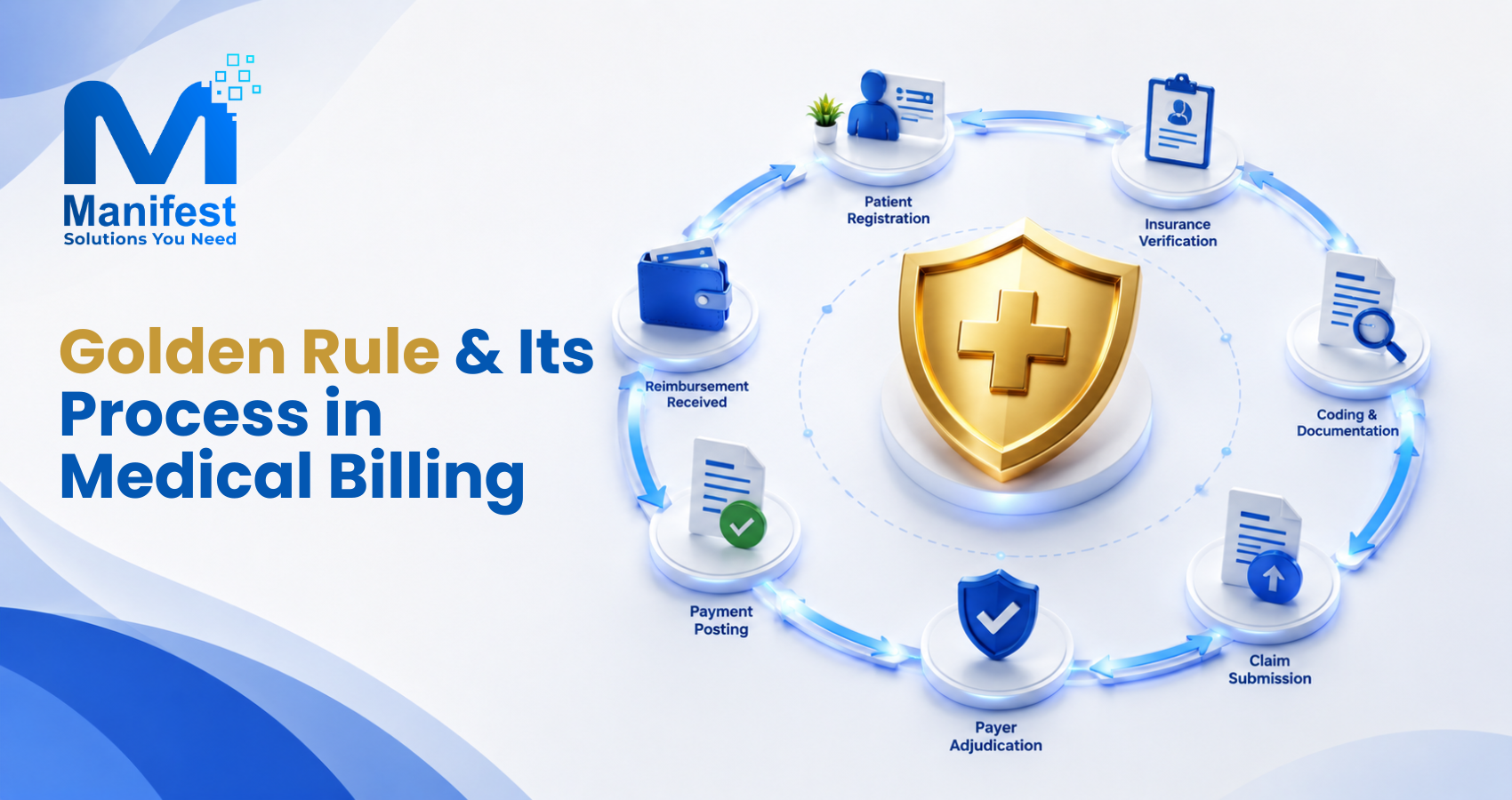
Medical billing errors can quietly impact a healthcare practice’s financial stability. Something as small as a missing detail, inaccurate code, or incomplete documentation can result in denied claims, delayed payments, compliance concerns, and patient dissatisfaction. In an increasingly complex healthcare landscape, providers cannot afford preventable billing mistakes.
That’s why one principle remains at the center of successful revenue cycle management:
“If it isn’t documented, it didn’t happen.”
This is known as the golden rule of medical billing. Every treatment, consultation, procedure, test, and patient interaction billed to an insurance payer must be clearly documented in the medical record. Without proper documentation, even correctly coded claims can still be denied.
In this comprehensive guide, we’ll explore:
- What the Golden Rule in medical billing means
- Why it matters in healthcare revenue cycle management
- Step-by-step medical billing processes
- Common challenges and solutions
- Best practices for optimizing claims
- How healthcare organizations can maximize reimbursements
What Is the Golden Rule in Medical Billing?
The Golden Rule in medical billing refers to a simple but powerful principle:
“Bill accurately, compliantly, and completely the first time.”
This means healthcare providers and billing professionals should ensure that every claim submitted is:
- Correct
- Properly coded
- Fully documented
- HIPAA compliant
- Submitted on time
If documentation is incomplete or inconsistent, the claim may be rejected even when the treatment was legitimately provided.
This rule connects three essential components of revenue cycle management:
- Documentation
- Medical Coding
- Claim Submission
When these elements align properly, healthcare providers can submit clean claims that are processed faster and with fewer denials.
Why the Golden Rule Matters in Medical Billing
Documentation is more than a legal requirement. It is the foundation of reimbursement accuracy and compliance.
Complete patient records help healthcare providers:
- Support medical necessity
- Prevent coding errors
- Reduce claim denials
- Prepare for payer audits
- Improve communication across care teams
- Strengthen revenue cycle performance
Poor documentation can create serious billing issues, including:
- Claim rejections
- Underpayments
- Delayed reimbursements
- Compliance penalties
- Increased audit risk
Accurate records also improve transparency for patients by reducing billing confusion and unexpected charges.
Understanding the Medical Billing Process
The medical billing process involves multiple stages that work together to ensure healthcare providers receive payment for services rendered.
Every step affects claim accuracy and reimbursement outcomes. If one stage fails, the entire revenue cycle can be disrupted.
The complete medical billing workflow includes:
- Patient registration
- Insurance verification
- Prior authorization
- Medical coding
- Charge entry
- Claim creation
- Claim scrubbing
- Claim submission
- Insurance adjudication
- Payment posting
- Denial management
- Patient collections
Healthcare organizations with efficient billing systems understand that clean claims begin long before claims are actually submitted to insurance payers.
Step 1: Accurate Patient Registration
Patient registration is the first and one of the most critical stages in medical billing.
Many claim denials actually begin at the front desk due to incorrect demographic or insurance information.
Common registration mistakes include:
- Misspelled patient names
- Incorrect insurance IDs
- Wrong dates of birth
- Outdated insurance plans
- Missing subscriber information
Even a simple typo can cause a claim rejection before the payer even reviews medical necessity.
Front-end accuracy is essential because it sets the foundation for the entire claims submission process.
Healthcare providers should always verify:
- Insurance eligibility
- Group numbers
- Referral requirements
- Contact details
- Coverage limitations
Many practices now use automated eligibility verification tools to reduce manual errors and improve billing efficiency.
Strong patient registration processes significantly improve clean claim rates and reduce denial management workload later in the revenue cycle.
Step 2: Insurance Verification and Eligibility Checks
Insurance verification is one of the most effective ways to prevent avoidable claim denials.
Before treatment begins, billing staff should confirm:
- Active insurance coverage
- Copay requirements
- Deductible status
- Authorization requirements
- Covered services
- Referral requirements
Failure to verify eligibility can create major reimbursement issues.
For example, a patient may present an insurance card that appears valid, but the policy could be inactive or out of network. If the provider fails to verify coverage before services are rendered, reimbursement may be denied entirely.
Insurance verification also improves patient communication regarding financial responsibility. Patients are more likely to pay balances when they understand their coverage beforehand.
This step plays a major role in reducing accounts receivable delays and improving overall healthcare billing workflow efficiency.
Step 3: Prior Authorization Management
Prior authorization has become one of the most common reasons for claim denials in modern healthcare billing.
Many insurance companies now require approval before certain procedures, medications, imaging services, or specialty treatments are performed.
If authorization details do not match:
- CPT codes
- Service dates
- Provider information
- Treatment plans
The claim may be denied even if the treatment was medically necessary. Managing prior authorizations requires close coordination between providers, clinical staff, and billing teams.
Healthcare organizations that fail to track authorizations properly often experience:
- Delayed reimbursements
- Increased denial rates
- Lost revenue
- Administrative inefficiencies
Strong authorization workflows are now essential for maintaining clean claim submission performance.
Step 4: Medical Coding and Documentation
Medical coding transforms healthcare services into standardized billing codes used by insurance payers.
The most common coding systems include:
- ICD-10 diagnosis codes
- CPT procedure codes
- HCPCS codes
Coding accuracy is one of the most important parts of medical billing because reimbursement depends entirely on proper code selection.
Incorrect coding can result in:
- Denied claims
- Underpayments
- Compliance violations
- Audit risks
- Fraud investigations
However, coding accuracy depends heavily on documentation quality.
Coders cannot assign proper codes if provider documentation is incomplete, vague, or inconsistent.
For example:
- Missing procedure details may prevent accurate CPT coding
- Incomplete diagnoses may trigger medical necessity denials
- Lack of documentation may cause downcoding
This is why clinical documentation improvement programs are becoming increasingly important in healthcare revenue cycle management.
Healthcare organizations that prioritize documentation accuracy generally achieve better reimbursement outcomes and lower denial rates.
Step 5: Charge Entry and Claim Creation
After coding is completed, charges are entered into the billing system and claims are created for submission.
This process includes:
- Linking diagnosis codes
- Assigning procedure fees
- Reviewing provider documentation
- Validating claim information
Even though this stage appears administrative, it plays a major role in claim accuracy.
Common charge entry errors include:
- Duplicate charges
- Missing procedures
- Incorrect modifiers
- Wrong provider information
Billing teams must carefully review every claim before submission because small inconsistencies can lead to claim rejection or delayed reimbursement.
Automated billing software helps reduce manual entry errors and improve overall revenue cycle performance.
Step 6: Claim Scrubbing and Clean Claim Submission
Claim scrubbing is one of the most important steps in modern medical billing.
A clean claim is a claim submitted without errors, missing information, or compliance issues that would prevent timely payer processing.
Claim scrubbing systems review claims for:
- Coding inconsistencies
- Missing modifiers
- Invalid insurance details
- Documentation gaps
- Formatting errors
- Payer-specific rule violations
Healthcare organizations with strong claim scrubbing processes generally achieve higher first-pass claim acceptance rates.
Industry experts consider clean claim rate one of the most important revenue cycle management KPIs because it directly reflects billing efficiency and operational performance.
Practices with poor clean claim rates often struggle with:
- Revenue leakage
- Rising denial rates
- Delayed cash flow
- Administrative overload
Submitting clean claims the first time is one of the fastest ways to improve financial stability in healthcare organizations.
Step 7: Insurance Adjudication and Reimbursement
Once claims are submitted electronically, insurance companies begin the adjudication process.
During adjudication, payers review:
- Eligibility
- Coverage rules
- Medical necessity
- Coding accuracy
- Authorization requirements
Claims may be:
- Approved
- Rejected
- Denied
- Partially paid
Electronic claim submission has significantly improved processing speed, but insurance companies now use advanced automated review systems that aggressively flag billing inconsistencies.
Because of this, payer-specific billing knowledge has become increasingly important for healthcare providers.
Organizations that stay updated on payer policies generally experience faster reimbursements and fewer claim disputes.
Step 8: Denial Management and Appeals
Denial management is one of the most expensive and time-consuming areas of healthcare billing.
Industry reports estimate that denial rates continue to rise, while many denied claims are never reworked or appealed.
Common denial reasons include:
- Incorrect coding
- Missing documentation
- Eligibility failures
- Lack of authorization
- Duplicate billing
- Timely filing violations
An effective denial management process includes:
- Denial tracking
- Root-cause analysis
- Appeals management
- Workflow optimization
- Staff education
Healthcare providers that actively monitor denial trends can identify recurring billing issues and prevent future revenue loss.
Strong denial management does not just recover denied claims. It improves the entire revenue cycle management process over time.
Best Practices for Improving Clean Claim Rates
Healthcare organizations that consistently maintain strong clean claim rates usually follow several key best practices.
1- Invest in Staff Training
Billing and coding regulations constantly evolve. Ongoing staff education is essential for maintaining coding accuracy and compliance.
2- Strengthen Documentation Workflows
Providers should document services thoroughly and clearly to support proper coding and medical necessity requirements.
3- Use Automated Billing Software
Modern medical billing software helps reduce manual errors through:
- Claim scrubbing
- Eligibility verification
- Denial tracking
- Revenue analytics
4- Monitor Revenue Cycle KPIs
Important healthcare billing KPIs include:
- Clean claim rate
- Denial rate
- Days in accounts receivable
- Net collection rate
- First-pass resolution rate
5- Perform Regular Audits
Internal audits help identify:
- Coding issues
- Compliance risks
- Workflow inefficiencies
- Revenue leakage
Healthcare organizations that focus on continuous process improvement generally outperform competitors in reimbursement efficiency.
The Role of Technology in Modern Medical Billing
Technology continues to transform healthcare revenue cycle management. Artificial intelligence and automation are now helping providers:
- Detect coding errors
- Predict claim denials
- Automate repetitive billing tasks
- Improve reimbursement forecasting
Electronic health records (EHRs) also play a critical role in improving documentation quality and coding accuracy.
As payer requirements become more complex, healthcare organizations increasingly rely on automation to maintain operational efficiency and financial performance.
Why Outsourcing Medical Billing Is Growing
Many healthcare providers now outsource medical billing services to specialized revenue cycle management companies.
Outsourcing offers several advantages:
- Access to certified coders
- Improved denial management
- Better payer knowledge
- Reduced administrative burden
- Faster claim processing
Medical billing companies often have advanced technology and dedicated teams focused entirely on reimbursement optimization.
For smaller practices, outsourcing can improve revenue cycle performance without requiring large in-house billing departments.
Final Thoughts
The Golden Rule and its process in medical billing remain essential for healthcare providers navigating today’s increasingly complex reimbursement environment.
Medical billing success depends on far more than claim submission alone. It requires accurate documentation, clean coding, strong insurance verification workflows, efficient denial management, and consistent compliance with payer guidelines.
Healthcare organizations that follow the Golden Rule consistently experience:
- Higher clean claim rates
- Faster reimbursements
- Lower denial rates
- Better cash flow
- Improved patient satisfaction
- Stronger financial stability
In modern healthcare, accurate documentation and clean claim submission are no longer optional administrative tasks. They are critical revenue protection strategies.
Providers that invest in strong medical billing processes today will be far better positioned to improve operational efficiency, and remain financially competitive in the future.
FAQs
What is the Golden Rule in medical billing?
The Golden Rule in medical billing means submitting claims that are accurate, complete, compliant, and fully supported by documentation the first time.
Why are clean claims important?
Clean claims reduce denials, improve reimbursement speed, lower administrative costs, and strengthen revenue cycle performance.
What causes most claim denials?
Common denial reasons include coding errors, missing documentation, eligibility issues, prior authorization failures, and incorrect patient information.
What is claim scrubbing in medical billing?
Claim scrubbing is the process of reviewing claims for errors before submission to insurance companies to improve clean claim rates and reduce denials.
How can providers improve their clean claim rate?
Providers can improve clean claim rates through accurate documentation, insurance verification, staff training, automated billing software, and regular billing audits.